AI Doesn't Fail on Models. It Fails on Data Ownership.
Data quality without ownership is theater. How lifecycle gaps between engineering, science, and analytics quietly kill AI — and the operating model that makes production possible.
Most stalled AI programs did not fail because the wrong foundation model was chosen. They failed because nobody owned the feed that model depended on — freshness, schema, lineage, definitions, and the last mile into a decision workflow.
Data quality is necessary. It is not sufficient. Without ownership, quality work becomes a cleanup sprint that decays the week after the consultant leaves. Analysts and data scientists absorb the tax. AI amplifies whatever is left behind.
Quality vs ownership
Quality answers: is this record complete, valid, timely, and consistent? Ownership answers: who is accountable when it is not — and what happens before a consumer (dashboard, model, agent) sees it?
Organizations often invest in catalogs, Great Expectations suites, and one-off remediation while leaving the harder problem untouched: no named owner, no consumer contract, no joint triage with engineering. The competitive moat framing still holds — but the moat is maintained by ownership, not by a single quality score.
Quality without ownership
- Cleanup sprints with no sustaining owner
- Checks that alert nobody who can fix root cause
- Definitions that drift per team spreadsheet
- AI pilots that look strong on a snapshot extract
Owned data products
- Named accountable human per critical dataset
- Schema, freshness, and completeness SLAs
- Published lineage from source → transform → consumer
- Quality gates in CI before models or agents train or serve
The data lifecycle — where quality is won or lost
Treat data as a lifecycle, not a warehouse dump. Failure modes cluster at the seams between stages — especially between transform, serve, and monitor.
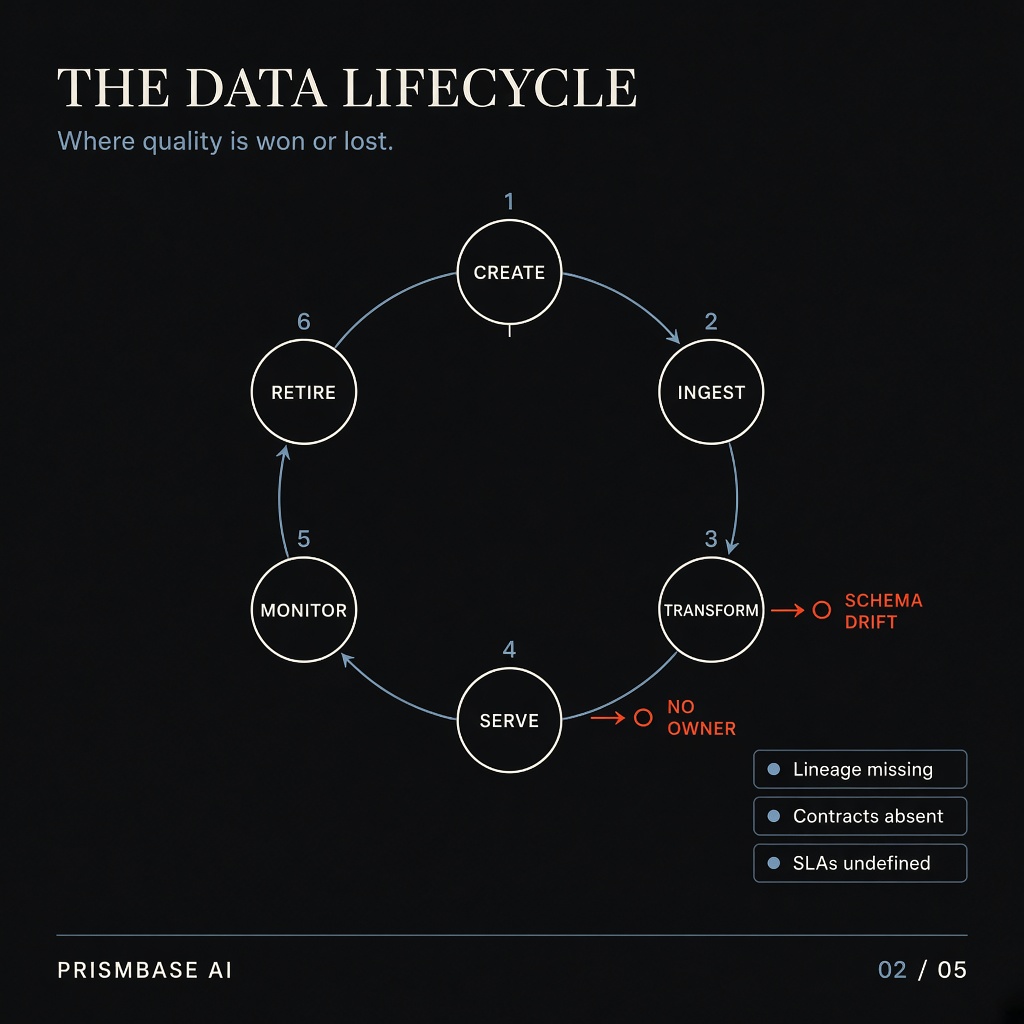
Typical failure modes we see in production reviews:
- Create / ingest: events without stable keys; late arrivals treated as complete days.
- Transform: silent schema drift; business logic duplicated in three pipelines.
- Serve:"the mart" with no owner; consumers discover breakage from wrong numbers, not alerts.
- Monitor: model drift dashboards without data drift ownership — so MLOps looks mature while the feed rots.
- Retire: deprecated tables still powering shadow notebooks and agent tools.
The broken handoff in the AI / analytics lifecycle
Data engineering, data science, analytics, and MLOps often run in parallel org charts rather than a sequenced production system. The coordination debt shows up as ticket queues, ad-hoc extracts, shadow pipelines, and silent schema changes.
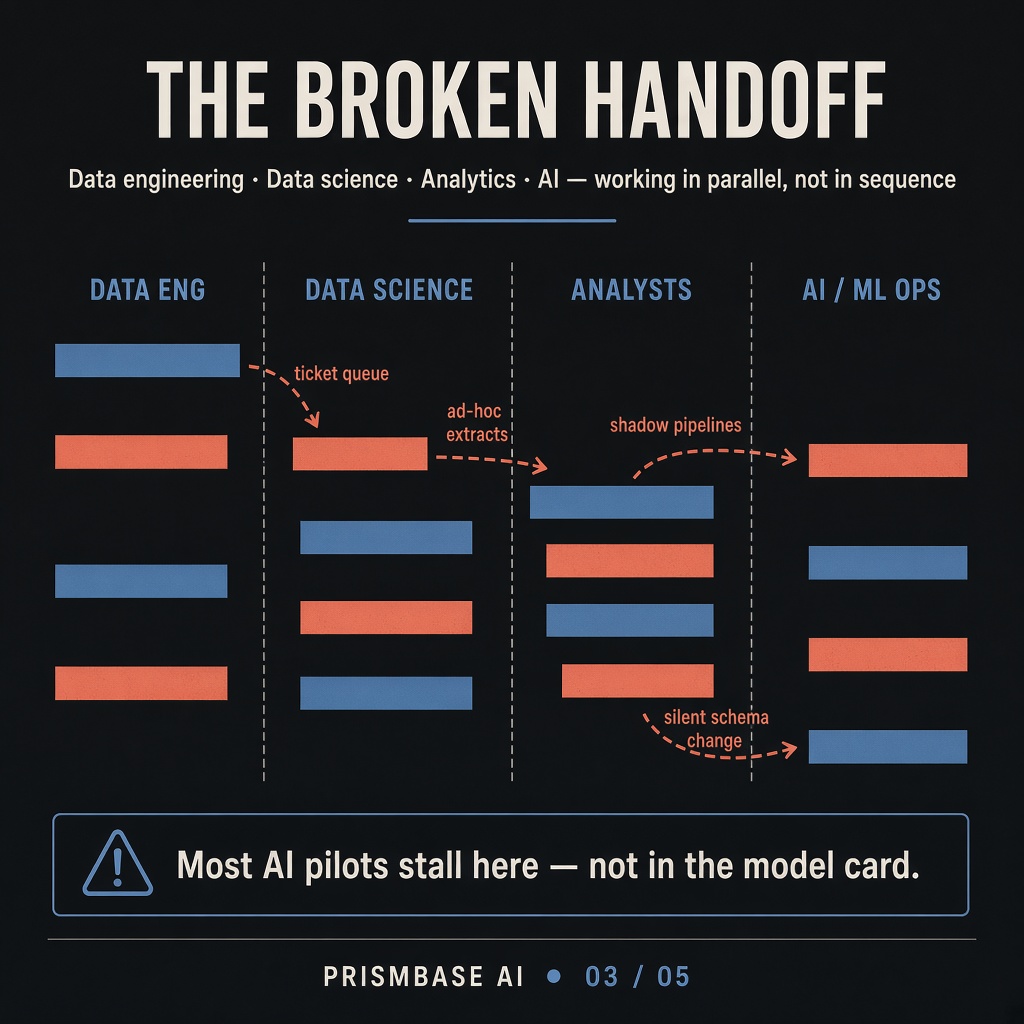
Concrete gaps that kill initiatives:
- DE ↔ DS: features requested via tickets; no shared contract on grain, latency, or null semantics.
- Analysts ↔ platform: one-off extracts become the unofficial source of truth for exec reporting.
- AI / agents: tools bound to stale tables; retrieval corpora without document owners or refresh SLAs.
- Eval contamination: labels and training windows that silently include leakage because lineage was never mapped.
What this costs analysts and data scientists
Skilled hours migrate into tax work: cleaning, reconciliation, hunting for trustworthy tables, debugging pipeline surprises. Modeling and decision support become the minority of the week.
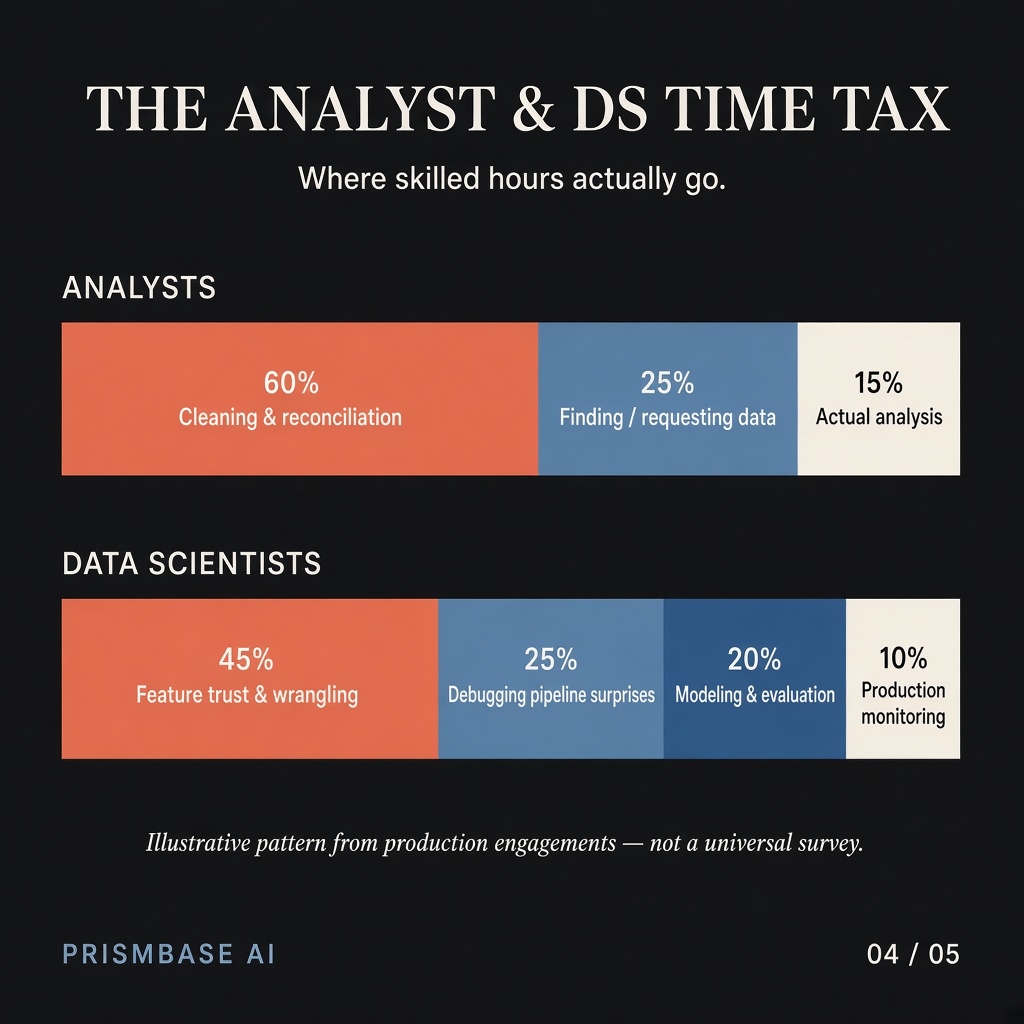
60%
Analyst hours in cleaning / reconciliation (illustrative)
45%
DS hours in feature trust & wrangling (illustrative)
15%
Analyst time left for actual analysis (illustrative)
That tax is not a soft-skills problem. It is an ownership and lifecycle design failure. Hiring more analysts into a broken feed multiplies the burn without compounding insight.
Why AI success depends on this
Classical BI can survive imperfect data with human skepticism. Production ML and agents cannot:
- Training: label noise and unstable features produce models that look good offline and fail under shift.
- Serving: online/offline skew from unowned transforms destroys trust in decisions.
- RAG / agents: retrieval over unowned corpora returns confident wrong answers — the worst failure mode.
- Evaluation: without lineage and contracts, you cannot tell model regression from data regression.
This is the same structural production gap that turns pilots into slop tax: activity without an operable feed.
Own it like a product
The operating model that survives contact with production is simple — harder to install than to state:
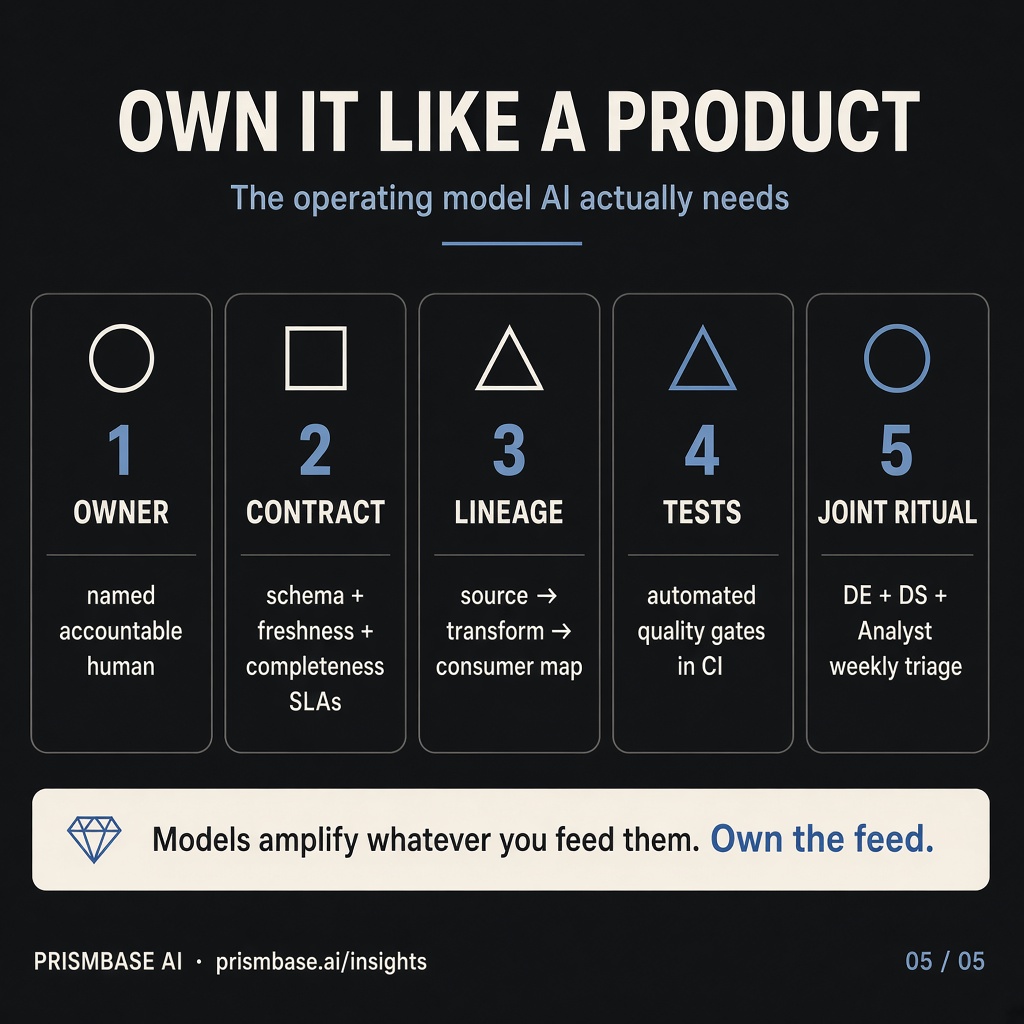
- Named accountable human per critical dataset or mart (not a Slack channel)
- Written contract: grain, schema, freshness, completeness, null semantics
- Lineage map from source systems through transforms to every consumer
- Automated quality gates in CI — fail the build before the model trains
- Weekly joint triage: data engineering + data science + analytics
- Explicit retire path for deprecated tables and agent tools
How PrismBase sequences the work
We do not start with a model bake-off. We start from your data posture: lifecycle seams, ownership voids, and the coordination gaps between engineering, science, and analytics. Then we contract for what ships.
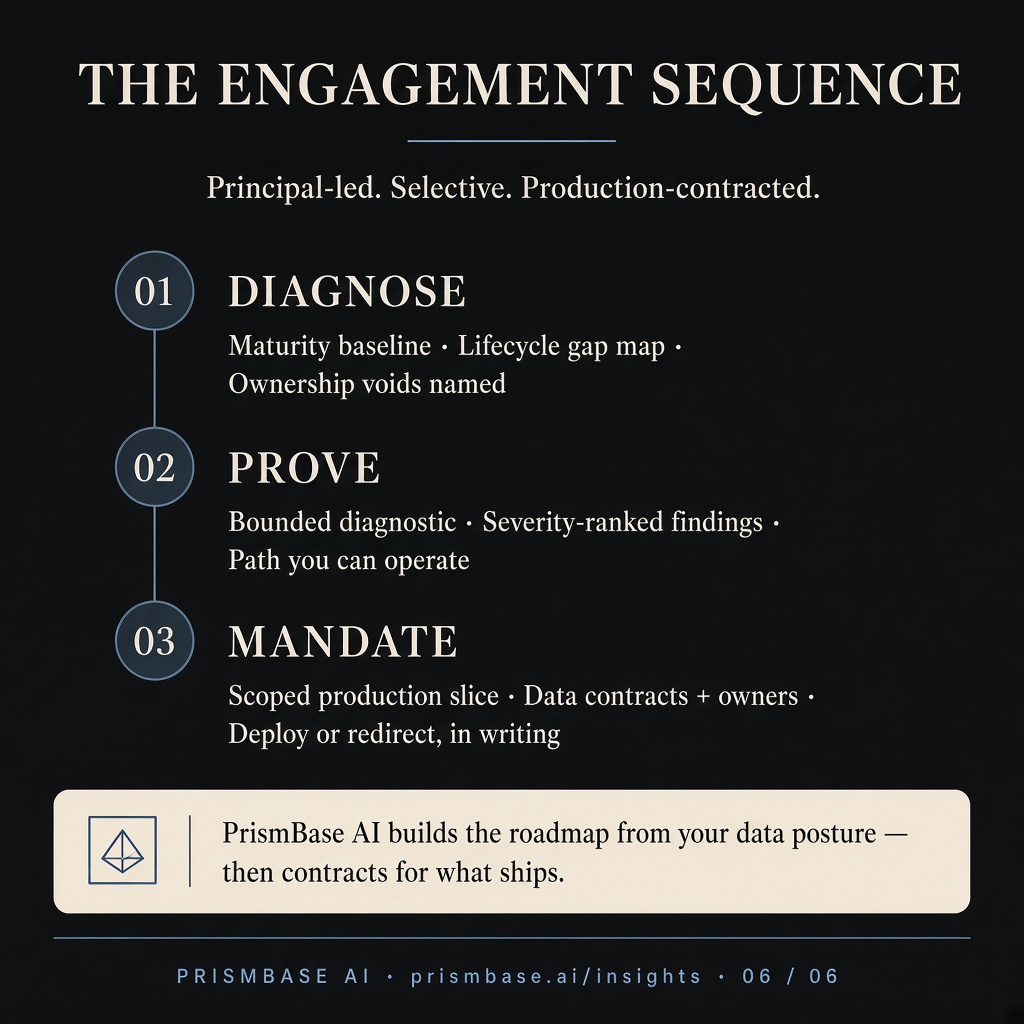
- 01
Diagnose
Maturity baseline, lifecycle gap map, ownership voids named. Free MLOps assessment available as a confidential starting point.
- 02
Prove
Bounded diagnostic with severity-ranked findings and a path your team can operate — capability proven before a larger mandate.
- 03
Mandate
Scoped production slice: data contracts, owners, monitoring, and deploy-or-redirect language in writing under the Production Standard.
Intake is selective. The roadmap is built from evidence in your stack — not a generic transformation deck. If the right move is redirect (simpler system, ownership first, kill the agent pilot), we say so. Reputation depends on what ships, not what is sold.
Start with the MLOps maturity assessment, read the data quality moat piece, or request a principal-led diagnostic.
Want the lifecycle gap map for your stack?
Principal-led diagnostic. Named ownership voids. A production sequence you can operate — or we redirect, contracted in writing.